 |
The Best of Philip E High
by Philip E High
(Cosmos Books, US$15.99, 197 pages, 2003.)
I have fond memories of the novels of Philip E. High. I recall finding
an Ace Double edition of The Mad Metropolis in a secondhand 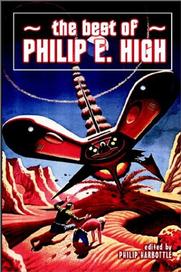 bookshop
in Melbourne when I was in my teens, and being swept away by its heady
rush of ideas and action-adventure. Months later I tracked down Prodigal
Sun and, my favourite, The Time Mercenaries--the latter about
a submarine's crew revived from death and brought to a future age to
fight off alien invaders on behalf of an evolved, effete human race.
Over the course of the next few years I read every book-length work
by High (with the exception of Blindfold from the Stars, still
a hard book to locate) and enjoyed them all. It has been said that High
is a pessimistic writer, a Dystopian; it has also been said that he
begins his novels (and it's often true of his short stories, too) from
a 'worse-case-scenario' standpoint, after which things get increasingly
better--an effective dynamic for the propulsion of an exciting storyline. bookshop
in Melbourne when I was in my teens, and being swept away by its heady
rush of ideas and action-adventure. Months later I tracked down Prodigal
Sun and, my favourite, The Time Mercenaries--the latter about
a submarine's crew revived from death and brought to a future age to
fight off alien invaders on behalf of an evolved, effete human race.
Over the course of the next few years I read every book-length work
by High (with the exception of Blindfold from the Stars, still
a hard book to locate) and enjoyed them all. It has been said that High
is a pessimistic writer, a Dystopian; it has also been said that he
begins his novels (and it's often true of his short stories, too) from
a 'worse-case-scenario' standpoint, after which things get increasingly
better--an effective dynamic for the propulsion of an exciting storyline.
Two stories in this collection (High's first, published almost twenty-five
years after his last novel) employ the same method. "To See Ourselves"
has a series of volunteers descend to an alien planet, and to almost
certain death, in the spirit of exploration; yet what the explorers
discover there will effect a dramatic and improving change on humanity.
"Psycho-Land" starts with the premise of an entire village sent mad
when a psychiatric experiment goes wrong: the malaise spreads, threatening
to engulf the entire land, until a man of integrity is sent in to solve
the problem--with uplifting effect.
Other stories fuse pessimistic scenarios with possible solutions.
High often pin-points humankind's failings, and then offers a grain
of hope: in "A Schoolroom for the Teacher" human expansion is commented
upon thus: "I hate to think," said Lange, "what they thought of Federation
history. The number of worlds we have - er - acquired, during our expansion,
the number of life forms pushed into reservations..." But it is humankind
which is about to be taught a lesson when a vegetable hive-mind hitches
a ride aboard the returning exploration vessel. In "Fallen Angel" an
evil human city is used as a testing ground for the probity of a superior
alien being--again with optimistic consequences.
The best stories in this volume are each quite different. "The Collaborator"
falls into the 'hope from despair' category: humanity is depicted as
corrupt and cynical, though one good man's collaboration with the alien
'invaders' suggests hope for the future. It's a spare, economical, and
incredibly fast-paced story, without a wasted word, a pastiche of the
American hard-boiled school of detective fiction, and excellently done.
"Risk Economy" posits a fascinating premise: a lone star-traveller
returns to Earth after nine hundred years to find a new form of economy
holding sway. Humankind is immortal, and in an effort to curb the population
growth, citizens earn credits in return for risks taken: there are enough
ideas in this story alone to furnish a complete novel.
"Routine Exercise" is my personal favourite. The crew of a Royal Navy
submarine falls through a hole in time and finds itself in the distant
past, there to encounter alien visitors to Earth. The detail of life
aboard the submarine is convincing, and the dark, dank mood, and the
sense of threat, is well conjured. The story closes with an interesting
twist, an effect High handles well in a number of his stories.
In "The Jackson Killer"--High's favourite of all the stories in this
volume--an assassin is sent to a colony planet to execute a 'Jackson',
a man deemed to be a threat to the stability of society: it's intriguing
and fast-paced and closes with another twist-in-the-tale dénouement.
These stories, edited for this collection with an informative introduction
by Philip Harbottle, were first published between 1956 and 1970, most
of them in the late fifties and early sixties. They are very much of
their time, an era in the genre when pace and ideas were valued above
such literary considerations as style and characterisation, and if a
cavil were to be levelled at the stories it would be on this count.
But it would be churlish to criticise High for not doing something he
never intended in the first place! What he does do, and does well, is
to present often interesting ideas in fast-paced, exciting and entertaining
stories typical of the best of the Golden Age of science fiction.

Review by Eric Brown.
Elsewhere in infinity plus:
|
|


